

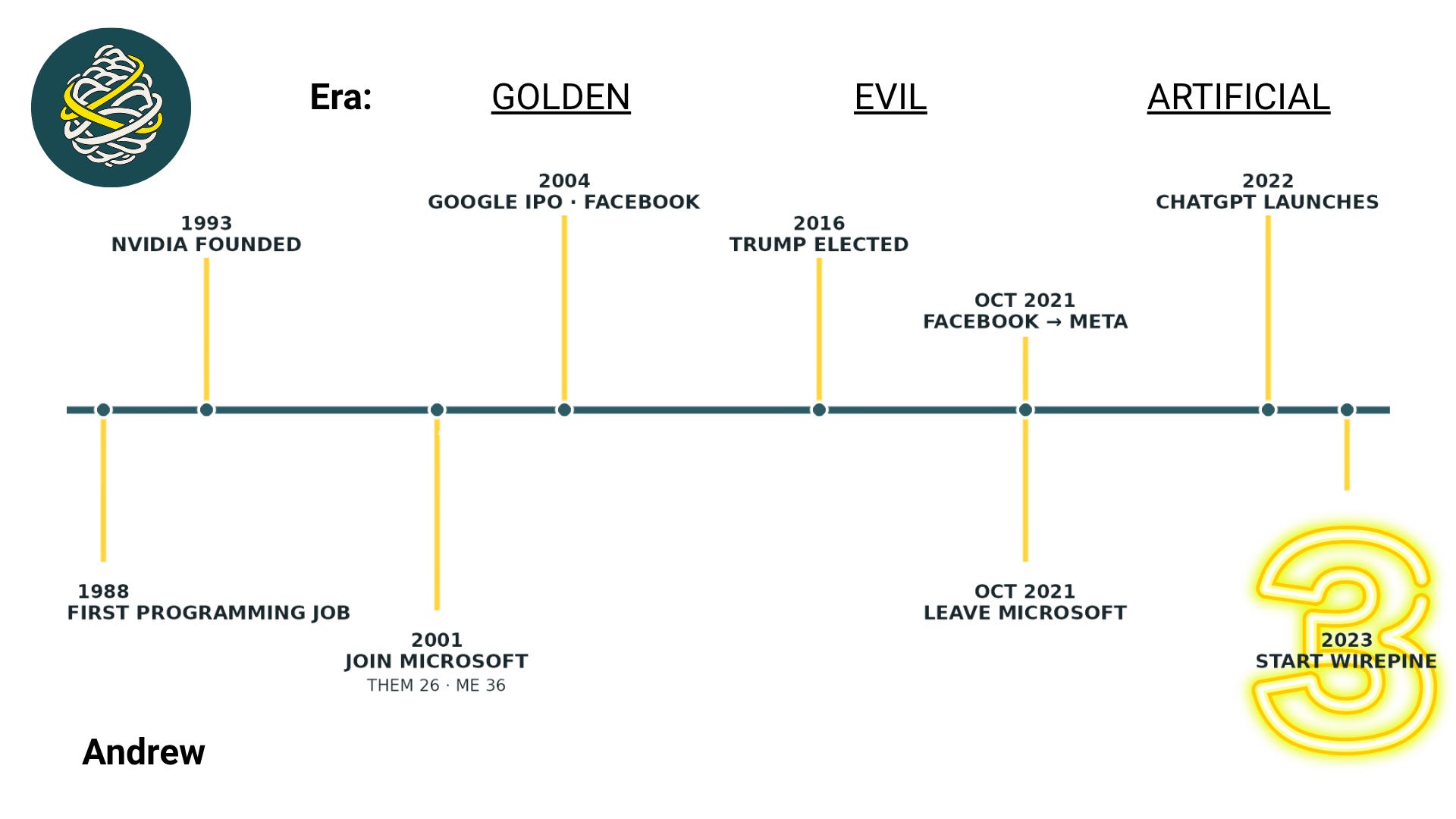
Microsoft turned 50 last year, but I was too busy nursing Wirepine through the terrible twos to care. I joined Microsoft in 2001, when they were 26 and I was but ten years older at 36. When I left twenty years later, we were both changed.
That first decade of my Microsoft career — the 2000s — was the Golden age of computing.
PCs were everywhere, the Internet connected us all together and software was this magical, burgeoning glue that made it all work together. Soon after I joined, Microsoft’s tagline changed from A PC on every desk (mission accomplished) to Enabling people to reach their full potential.
Through Microsoft software of course.
Google was a baby — barely three — when I started at Microsoft. A few years later, in 2004, they went public. That day, my BART train ride home from the city was buzzing with the news. At the end of the day Google was worth over $20 billion.
Google made a big deal in their IPO of their motto: Don’t be evil.
The Golden age brimmed with the promise and optimism of a future where tech would be overwhelmingly beneficial across the board.
But in a few years, tech took a turn towards evil.
Google grew fast and furious on the back of ads and targeting. Don’t be evil soon was demoted to a footnote in Google’s code of conduct.
Don’t Be Evil is also a new book just out by Claire Stapleton. I haven’t read it yet, but Claire is working the podcast circuit and as I listened to her describe her years at Google, initially teeming with idealism in the Don’t Be Evil Golden Age, and ending with her coordinating walkouts in Google’s Evil Age (as they were swept up in a wave of controversy ranging from harassment to surveillance to defense contracts) — I found myself nodding along.
Facebook appeared the same year Google IPO’d and while Google slid towards the dark side, Facebook ran towards it. Initially FB seemed harmless enough. Everyone I knew at Microsoft made an account and started sharing the cringiest details of their lives outside of work. I did too. It was novel. It was fun.
Then Facebook jumped on the ad train, building a targeting algorithm to rival Google’s. The FB algorithm builds your feed and decides what you see including ads, ads, ads. Special ads, just for you.
In 2016 the terrible power we created was revealed.
Between a comprehensive Russian impersonation and disinformation campaign and Cambridge Analytica’s microtargeting of Facebook ads, social media inflames divisions, radicalizes the web, and we got Donald Trump.
Instagram started out in 2010, at the cusp of good and evil. When Facebook acquired it a few years later they too, would bend to ads and the algorithm.
Google picked up YouTube in the Golden Age and like Instagram, it blew up in the 2010s embracing the evil age of the algorithm. These now massive platforms of curated content became the building blocks of the age we are in today — the Artificial Age.
Enough to train computers on language so we can just talk to them and they talk back, searching, analyzing, and creating anything we ask for.
There’s one missing ingredient the nascent Artificial Age needed to take off, and that’s chips. NVIDIA was founded just as PC gaming was taking off. They did ok, but when training AI became paramount they blew up. Turns out, the same parallel processing needed to paint video screens super fast is ideal for the math that builds the neural networks all of AI is built on.
The weird thing about the current Artificial Age is it alternates between Golden (good) and Evil. While cracks are showing in the evil empire — we’re collectively getting sick of crap like Facebook, and Google keeps stumbling in the AI race — big players like NVIDIA now have so much market power that worries abound that they’re feeding a circular financing cycle of funding AI frontier labs like OpenAI and Anthropic, based on commitments to buy more of their chips.
It’s a house of cards, err chips, that might come crashing down.
AI burst on the scene a couple of years after I left Microsoft (not retired!). In AI, I felt that same sense of profound tech optimism that fueled my fascination with computers and propelled my early career. Knowing what I do about computers, AI was (IS) magical and I couldn’t sit on the sidelines as this new wave of tech swept up everything.
So I started Wirepine, and now I use AI to update old but still important tech (websites). Wirepine gives me a front row seat to how the Artificial Age is changing computing and the internet. And let’s not kid ourselves: given how pervasive tech became during the Golden and Evil Ages, how AI is changing society as a whole.
If Microsoft and Google were the optimists of the Golden Age with a PC on every desk empowering us all to reach our full (not evil) potential, who are the new optimists of this Artificial Age?
Shocker — it’s the frontier AI labs, and their taglines all rhyme:
OpenAI wants AGI to benefit all of humanity.
Google DeepMind promises to build AI responsibly to benefit humanity.
Anthropic builds AI to serve humanity’s long-term well-being.
Tech went from wanting a PC on every desk to the welfare of the entire species.
Well, I hope so. What comes after the Artificial Age? We’ll know in a few years if it’s a Golden or Evil Age of AI.
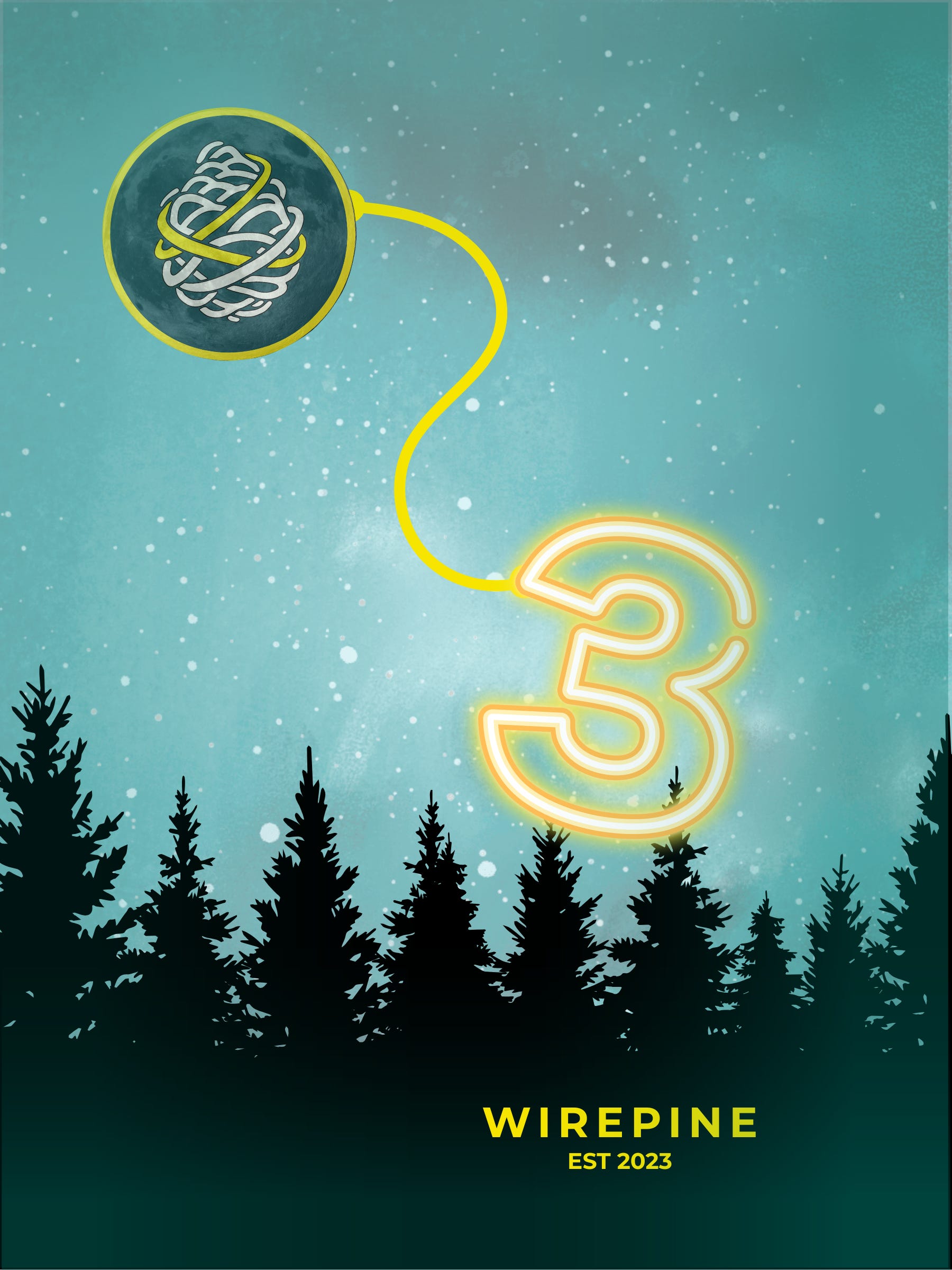
This is the working version of my 3-year anniversary Tee. If you want one, let me know your size. It’s going to be green and I found the perfect comfy brand. Big design on the back; new logo on front.
Wirepine’s tagline is Websites Made Easy.
After nearly 40 years of tech, maybe I should change it.
Don’t be ugly.
What I like here is that you’re not pretending the early tech era was pure. It just felt more innocent because we hadn’t seen the downstream effects yet.
Happy 3rd to Wirepine. Not bad for something born in the middle of the Artificial Age. 😂
Happy Monday Andrew
Love this history lesson. Happy Birthday Wirepine! I can attest that you not only made my website function better, it is also a lot more beautiful! Thank you!