

The thing about the town was that there was no “there” there, no soul, only sprawl. I was stuck out in the ex-urbs, over the bay, through the tunnel and across the valley, far from San Francisco, out where the towns blur together.
The grind had no color.
Campus was a collection of matching gray rectangles facing off across a concrete courtyard. I worked in building Three. Inside a repurposed conference room (the ‘war’ room), my home was the middle desk in a string lining the wall, each with just enough room to squeeze in a putty keyboard and monitor.
This was the west coast backup datacenter for Bank of America; the bottom two floors of the building were packed with machines. Towering exhaust pipes punched through the roof to vent a battery of backup diesel generators. Should calamity take San Francisco offline, the generators would fire up and Concord would swap in and the Bank would keep cashing checks.
My daily route passed under a faded set of banners proclaiming nonsense like Inclusive Meritocracy and Passion for Winning. Inside the war room, my posse of vendors worked on building out possibly the largest corporate e-mail system of its time and my god it was taking forever.
So, perhaps I was a little tired, tech-weary, tangry1 even when SMS (AKA texting) appeared on the scene as the new tech phenomenon. In the midst of designing the massive distributed storage system needed to keep all the Bank’s email, I scoffed at the 160 SMS text character limit — who’s going to use this?

A couple years later, trying to comprehend the $500 phone bill in my hand and the associated 3,000 texts my teenage daughter had sent that month, I got my answer.
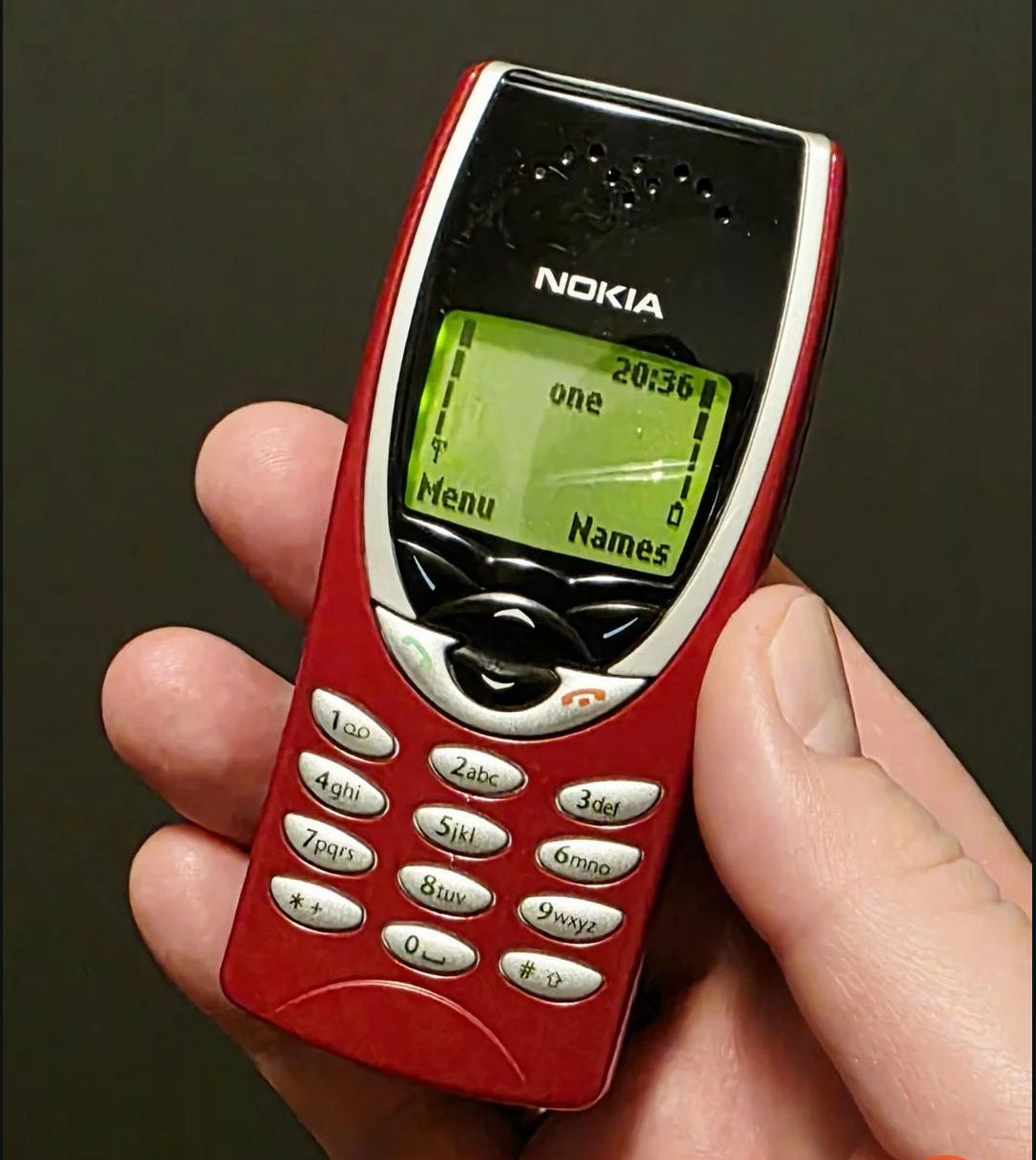
A bright spot from that gray period, was my favorite phone ever, the Nokia 8120. No keyboard. Texting Hello on that phone took over 20 taps. So, no texting. The 8120 existed in a moment when miniaturization was peak and a phone didn’t need a keyboard. It was a glorious device with one job — talking on the phone.
It wouldn’t be long before texting surpassed voice and it all started with a simple hack. Phone networks have a signaling channel to go along with the one that carries your voice. The signaling channel sets up the call, manages handoffs between cell towers, etc. It’s idle most of the time.
A few engineers figured why not use the signaling channel to send system messages? The channel capacity was 140 bytes — enough for exactly 160 characters.2
What can you do with 160 character messages?
Friedhelm Hillebrand did the math. He was working on the new European GSM cell phone standard and he knew the constraints. Friedhelm checked old telegrams, postcards, FAXes. He counted the words, he counted the letters, and yep, turns out you can say plenty in 160 characters. And so it was.
While texting took off thanks to teenagers (not the first, not the last cultural revolution spawned by teens), SMS quickly stormed the world of corporate communications and chat became the way work got done. That was my ticket out of building email systems and into the emergent and colorful world of chat based comms.
SMS became Texting, texting begot Twitter. The original little blue bird was even more constrained than SMS — you had to fit a username in too, so now you had only 140 characters to craft your message.
With Twitter you could reach and build an audience — it was social, it became tweets, chat. In came iMessage, WhatsApp, SnapChat, Slack, Discord. With each iteration, constraints like length peeled away while chat capabilities grew — broadcast, GIFs, disappearing messages, group chats.
Chat is now baked into every tech stack on the planet and of course it’s how we communicate with our current disruptor AI.
While SMS and its subsequent chat brood forced brevity, optimizing for meaning and impact, our latest chat monster, AI, has the opposite problem. AI talks too much.
AI needs to STFU.
AI is built around a different set of limits. Last week, 14-year old Shrey Parikh won the National Spelling Bee with the winning word “bromocriptine.” Shrey didn’t know that word but he knew the pieces: bromo (from the chemical bromine), crypt (from Greek kryptos meaning hidden) and finally -ine (a common chemical suffix). bromo + crypt + ine.
Shrey knows how you win a spelling bee. You can’t learn every word, but if you know the underlying components every single word is made up of, when you get a doozy like bromocriptine, with a bit of info about its definition, origin and pronunciation, you can figure out how to spell it.
AI uses a similar trick. It’s called tokens.
Rather than chunking words out into their piece parts, AI chunks everything. It takes the entirety of every email, every chat, every book, post, newspaper, and blog it can get its hands on, and then, after ingesting it all, categorizes word parts that occur frequently, noting the order they occur.
These resulting word chunks are called tokens. Every response AI generates is assembled by ordering these tokens. While Shrey used semantics to break down and spell bromocriptine, AI uses statistics. Depending on the frequency of the letter sequences across its training data, AI might break it down as: brom + oc + ript + ine.
Tokens are the reason AI famously struggled to count the R’s in the word Strawberry. AI doesn’t see Strawberry as a single word or sequence of characters — it’s a collection of tokens like straw + berry. Tokens are also the reason AI is so verbose. While AI models are great at predicting what comes next; they suck at knowing when to shut up.
They don’t know when to stop, so they over-explain, they just … keep … going. There is always a next token. Bolt on an engagement strategy to keep the conversation going, ending every answer with another question, and congrats you just built the most annoying computer in the world.
Know your limitations.
Tangry = Tech + Angry
The GSM control channel was 140 bytes or (140 x 8) 1,120 bits of capacity. By using on 7 bits per character (1120 / 7) you got exactly 160 characters.
Interesting!
You've probably seen this by Andrej: https://youtu.be/7xTGNNLPyMI?si=UcR47c7auhZX0utq
I’ve been beta testing the newest in-car version of Gemini. The verbosity is driving me made, and no, I don’t want to find somewhere to stop along the way.
That corporate office in the beginning sounded like hell.