

Childhood Turquoise dreams led to a Pastel Yellow phone. The Trimline seemed to glow, beckoning to me from across the thrift shop.
I could not resist its pull.
When I lifted the handset, flipped it over and saw the rotary dial my heart springs twanged.
I’ll be making all my calls on this thing.
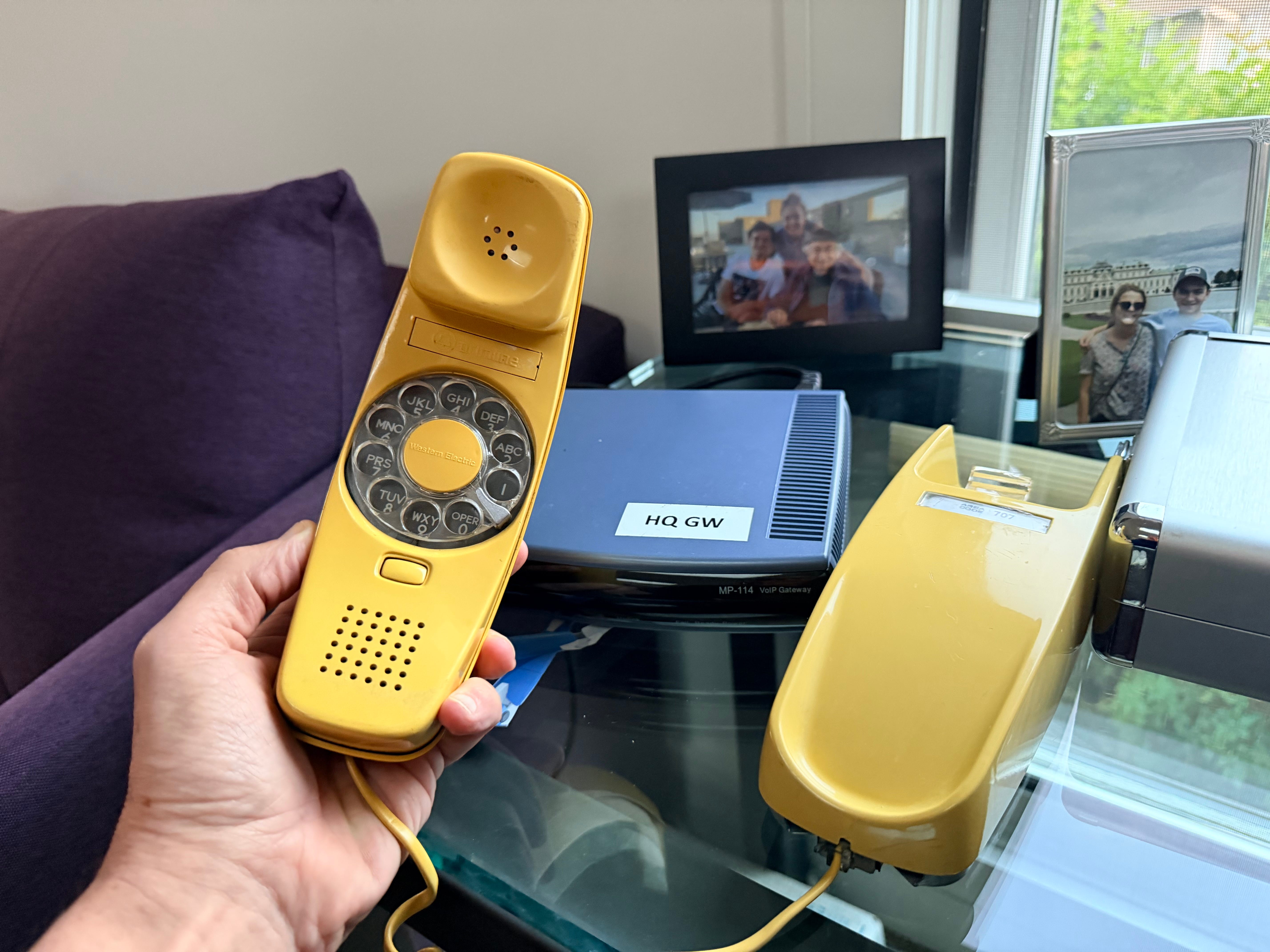
If I can get it to work.
The guy I bought it from promised me it works, but I dont trust that guy.
I made him write MONEY BACK underneath the red stamped NO RETURNS on the receipt; no dialtone, no keep.
$50 bucks for a hunk of plastic and metal nostalgia — a dollar for every year of its life — and who knows if it works. No one has POTS (plain old telephone service) anymore. And even if I found an analog plug hiding somewhere (with service behind it), the Trimline mounts on the wall with a special connector.
But I have a secret — phones used to be my whole thing.
I got an early taste.
Just married, I was a programmer/analyst for Alameda County Social services. I worked on the fifth floor, in a crusty, squat, blue five story building in downtown Oakland just off the freeway. Back then it featured linoleum, acoustic tiles and peculiar smells; it probably still does. Across the parking lot was the county morgue where the smokestacks ran nonstop, which no doubt contributed to the smell.
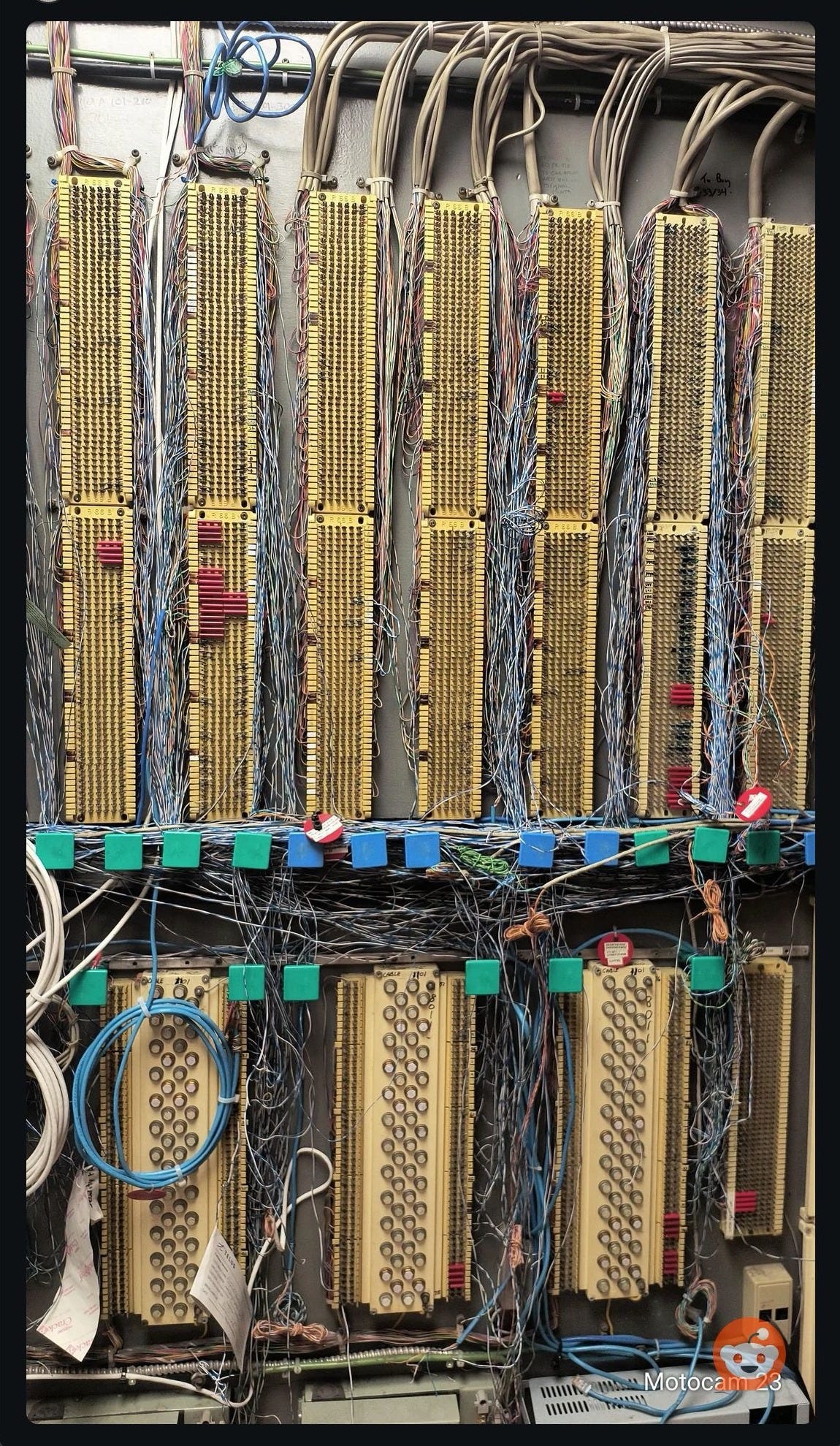
One day I was hanging out with the case workers (trying to understand their byzantine workflows) when I tripped across the guts of the building splayed out across the lobby. Pacific Bell was adding new phone lines, and thick bundles of wire were everywhere, snaking out from a phone closet just like the one above, like so many strands of Medusa’s hair.
The closet had committed hari-kiri, ejecting its entrails everywhere.
The yellow rectangles are punch down blocks and every single phone line is painstakingly mapped to a row, the correct wires are lined up (they’re color coded) and BAP BAP BAP — you hit it with a punch down tool that sounds like a machine gun — that jams the wire in to makes the connection.
I’d go on to pull miles more cable, but for computers not phones. From 2-wire terminal connections dangling from the ceiling like so many nooses, to fat token-ring cables, to fiber to Ethernet. Tons of Ethernet. I crawled under offices in bunny suits, fished wires through walls, lubed cable and pushed it through wire runs.
Greasy cube rat buddy Perry was the ringleader in my peak wire yanking days.
Today’s Ethernet standard calls for 8 wires — 4 twisted pairs — and it delivers gigabit speed. Yet, it has something in common with my yellow Trimline: the same modular cable adapter. You know — those little translucent box, stick-it & click-it connectors.
These bits of genius were dreamed up by the Bell Labs guys and they’re still going strong nearly 60 years later.
Old analog phones need just 2 wires to work and that connector is called an RJ11. An Ethernet cable — I bet you’ve plugged one in at least once in your life — that’s an RJ45. Same design, just a little fatter for 8 wires.
There are over 30 variations of RJ style connectors and I still have a crimping tool to make the Ethernet variety.
Wires used to be everywhere.
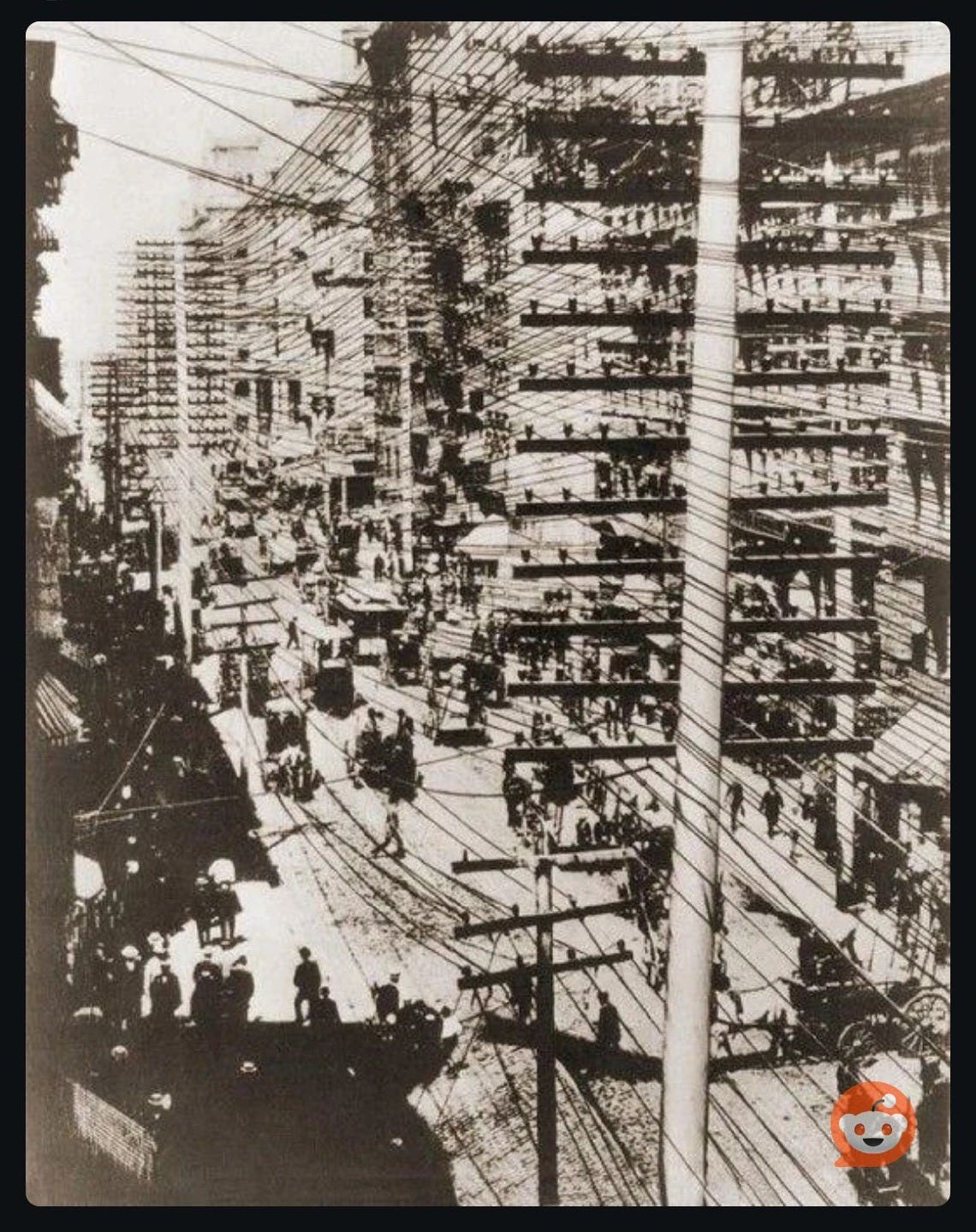
The massive telco network yielded its throne to the massive(r) Internet years ago.
Now it’s a digital world.
Enter the MP-114. That’s the blue box labeled HQ GW behind the phone in the first pic.
It’s a Gateway: a bridge between the old world and the new. Specifically, a VoIP gateway.
I graduated from pulling cables to building VoIP systems. Over my career I directly transitioned 100s of thousands of old analog phones and indirectly millions of them, to software systems like Skype & Teams.
VoIP (pronounced like oy: V-oy-P) stands for Voice over IP or moving the talking from the single purpose voice network to the general purpose data network (the Internet). Delivering voice over the internet was rough at first. We built media stacks piled high with magic codecs and error correction and ways to make sure a voice packet with was prioritized over everything else on the network.
Feeds and Speeds: thats what we called customer sessions where they’d grill us on this stuff.

The MP-114 was part of my work lab back then. When I left that life, I gave all my phone gear to a friend and former co-worker.
Thankfully, he saved it for me.
The back of the MP-114 has a bunch of ports. The trimline plugs into one and an Ethernet cable plugs into another. I’ll program the thing to support rotary dialing, etc. and then I’ll connect it to an online (free) VoIP service. Maybe I’ll splurge for a local number for a few bucks a month.
If the phone works, I can get the gateway to work. I just ordered the mounting plate and cables.
Next week I’ll know, and so will you.
I setup a Bluetooth record player for my in-laws a few weeks ago. The turntable needle converts the grooves etched into the vinyl into an electrical signal to reproduce the sound. But then it hands the signal off to a Bluetooth adapter that converts it into zeros and ones to play over a modern set of speakers.
Now they can play all their old records; it’s another analog-to-digital gateway.
But as much as we love them, Trimline phones and vinyl records are relics of a time when you could see the wires.
You carry the most sophisticated gateway in your pocket.
Your smartphone bridges connections between WiFi (data) and LTE (cellular), across Bluetooth and Satellite (including GPS) and of course the physical world of sights and sounds.
All with nary a wire in sight.
Yet, the wires persist. Telegraph cables turned into Telephone wires that turned into Data circuits, and now there are more wires than ever, criss-crossing the globe, connecting every home, business and datacenter.
The great mobile phone explosion may have hidden the wires, and now ‘unstoppable’ AI will have you believe it’s all software, but make no mistake, our digital world — like an ever-expanding ball, built up layer, upon layer, by more and more skinny beige, fat blue and bright red criss-crossing rubber bands — is held together by wires.
And wires can be cut.
Money back 😆