

As the Earth completes its annual celestial loop around the sun, we light candles, stuff stockings, cook cioppino. The cold that startled us in the fall settles in, the sky gets heavy, the days short.
Our usual rhythms taper off: finals finish, Christmas break starts, offices empty — even the bureaucracy slows (except the overworked souls at the post office counter).
It’s time to get away — to get away from it all.
For us, a postcard with a boat in a perfectly clear bay planted the seed. We were trying to shake an unexpected emotional hit and so we planned and we recruited.
We got away, leaving the day after Christmas. After a day of travel I’d sworn off, we made it to Baja: a warmer place, a new place.
The fishing village of Agua Verde lies in a dusty clearing at the base of the Sierra de la Giganta range — sharp mountains thick with thorny scrub and cactus, tucked into the southern corner of a sweeping crescent bay.
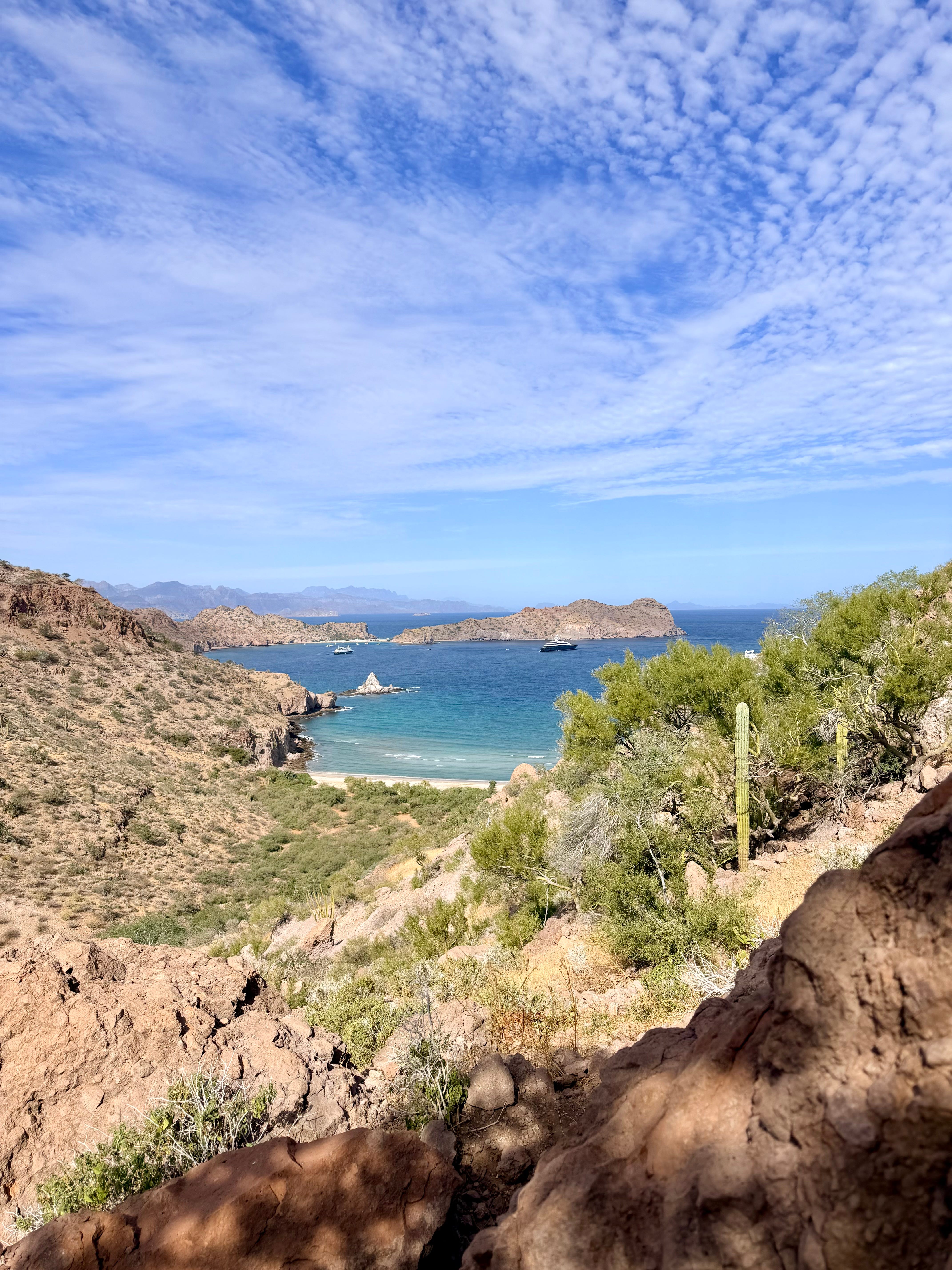
The morning haze hung over deep blue water while the wind and tide kicked up breakers, challenging our little Zodiac. As we crossed into the aquamarine of shallower water, our skiff driver valiantly gunned the engine to maintain position off the beach. With the bow holding steady, just nudging the sand, we swung our feet over the side, splashed into a few feet of cool water, and dashed up onto the rocky beach.
Balanced on a pile of uneven volcanic rocks, I switched out wet shoes for dry ones. Shoes secured, our little group gathered, and I was surprised someone had managed to bring a hefty hiking staff. He looked like a fellow traveler: round glasses perched above a bearded face, baseball cap on top, Patagonia fleece and pants.
In retrospect, perhaps he was a little more grizzled, a little riper, than the rest of us.
I complimented him on the hiking stick. He waved up the beach toward town, saying he’d found it up there, and it was still drying out. On the way in, I had noticed a cave about 30 feet above the beach with a small blue tent peeking out. This man was not from our boat. He told me he had been living in that cave and meditating for the past three and a half months.
Not only was he trying to get away from it all, he was trying to figure it all out.
He warned us the arroyo we were heading up was difficult, even impassable at points. Then this: the massive yacht that had followed us into the bay was Mark Zuckerberg’s.1 How did he know? There was no internet here; no Facebook flag flying. Maybe he was an ex-Facebook exec who snapped after a meeting with Mark, taking a swan dive off the upper deck.
More on Mark: “I’m trying to do the opposite of Mark — minimize all my possessions.” I wanted to congratulate him on that, but for all I knew he had a bowling alley in the back of that cave. He finished with “The older I get, the more I realize I don’t know anything,” that last bit punctuated with a few expletives.
I had questions, but we started up the arroyo and when I looked back, he was gone.
He wasn’t wrong about the hike. Goats make use of the arroyo, but they are short and their skin is thick. We were immediately pushing through angry brambles, navigating around spiky ocotillo and cactus. As we climbed, the gravel turned into treacherous, sliding scree. Each foothold became a negotiation with ledges that crumbled under our weight.
One bottle of water later, we emerged from the shadows onto the summit. Our view was interrupted by the thup-thup-thup of helicopter blades as Mark’s helicopter landed below on the bow of his yacht Launchpad:
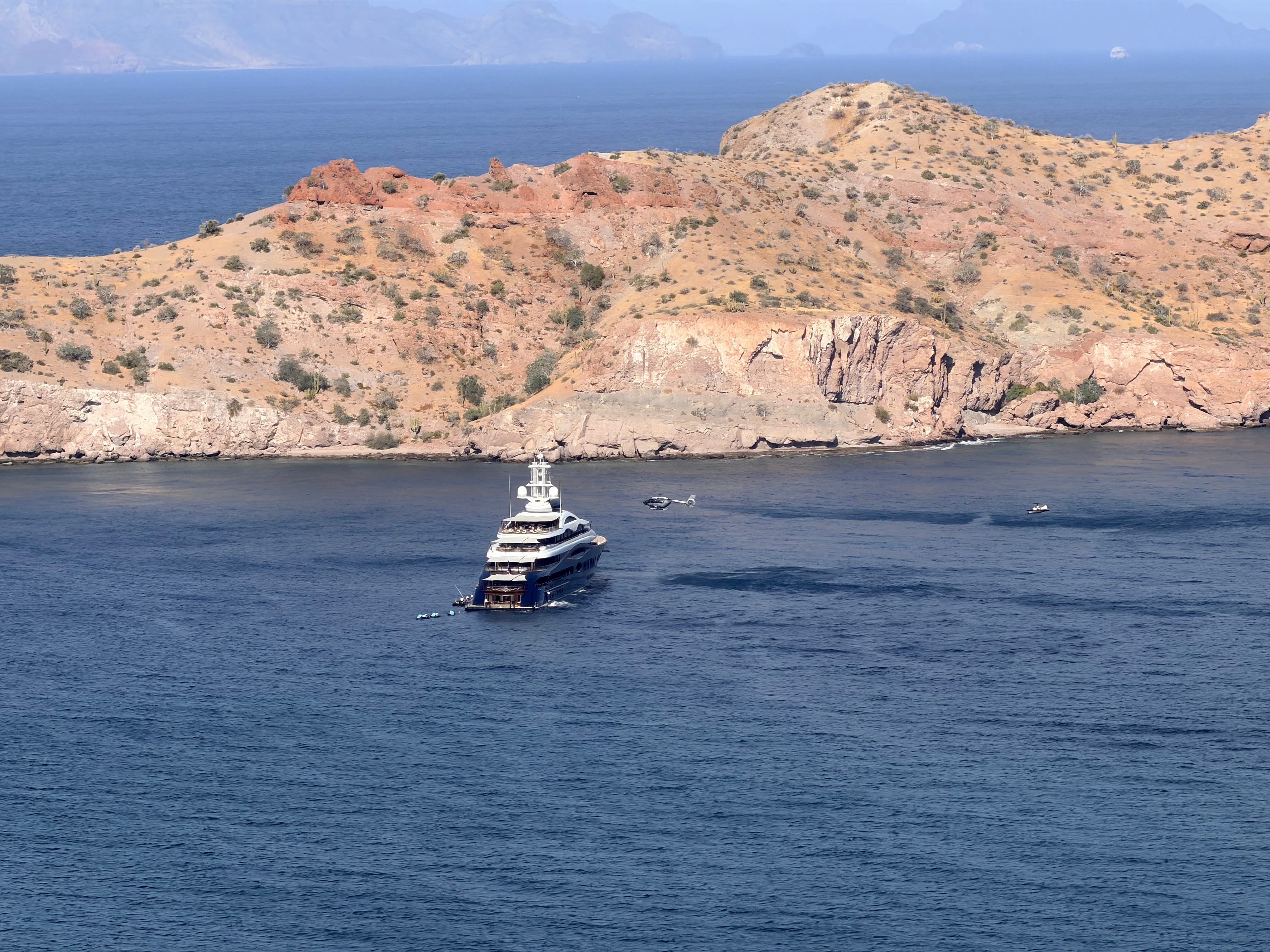
I wondered if Mark ever wants to get away from it all; when you own a $300 million yacht, I suspect it all feels pretty big.
I later learned from the crew that Mark’s sister Randi posted her Peloton workout from the deck of the Launchpad before heading ashore for a training run. Apparently she is a super duper extreme athlete. A bodyguard went with her, trying to shadow her through the thorny brush on an e-bike. Too bad the toy hauler doesn’t bring burros.
After a rest, we wound our way down to the little town of Agua Verde, navigating sharp scree drops and dodging voluminous evidence of a goat with an upset stomach. I wished for that hiking stick. Scree gave way to a dirt path as we approached the town.
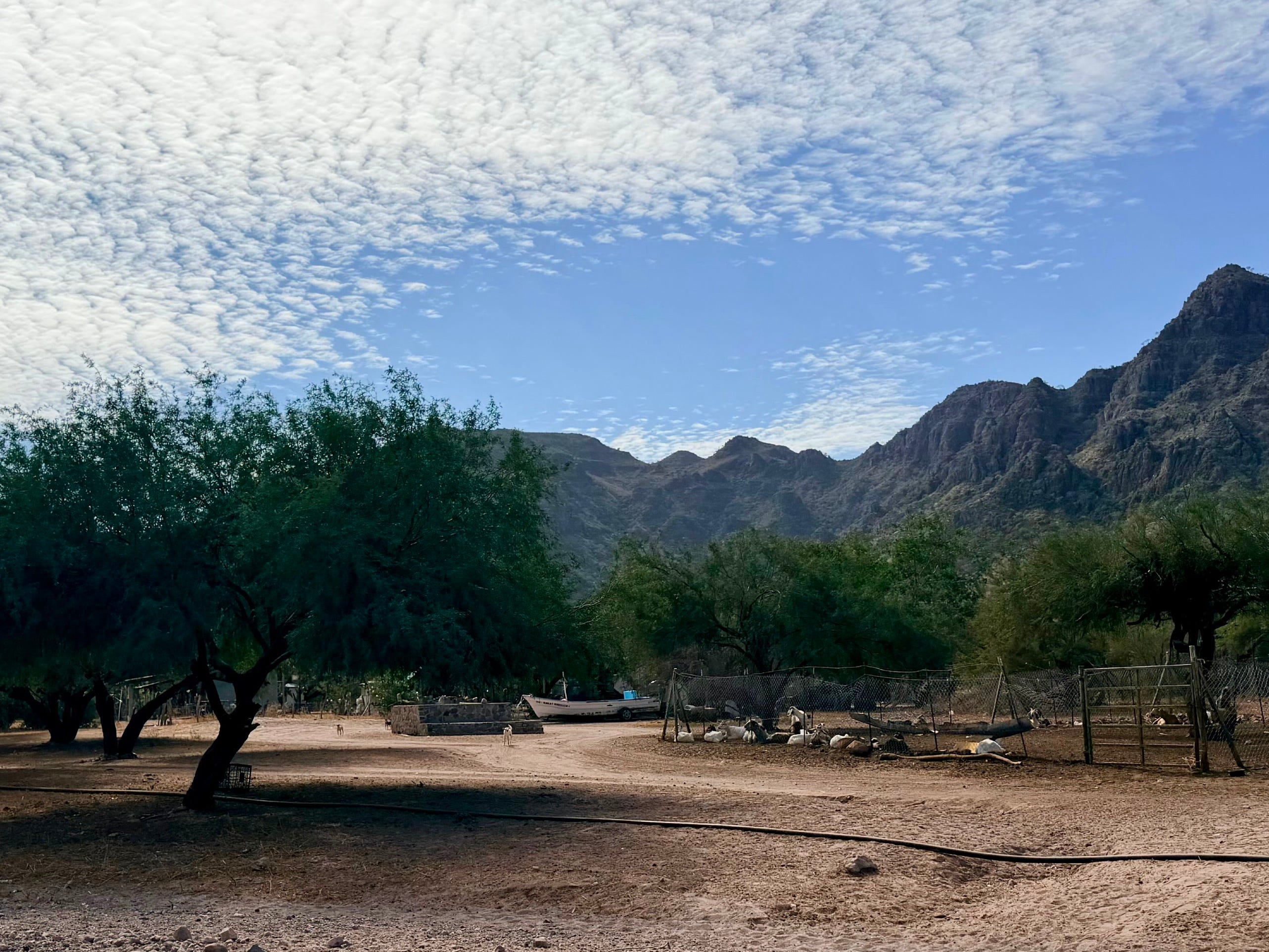
Walking past the school — the one small modern building — we crossed through town back to the beach. A posse of roaming dogs guarding goat pens welcomed us. We spotted fat pigs feeding and skinny cows grazing through brush.
Reversing the shoe trick, we claimed our life jackets, climbed back on the skiff, and headed back for the boat.
That afternoon we returned to shore, this time to the opposite side of the bay. It was quite warm now with the slightest breeze passing over glassy water. JFran had hiked the ridge on this side in the morning and she had met a man from Montana on the beach. He had been here two months, living in a homemade rig with his dog. His build fit in with the collection of vans dotting the beach.
Everyone searching for their version of getting away.
Heat radiating off the sand, we engaged in an unexpectedly elaborate matching process of burros and gringos. Vaqueros led each burro out from the shade of trees at the back of the beach, carefully scanning our group before dramatically pointing to the selected rider for each donkey.
Paired up with my beast, wondering about their criteria and oddly happy I didn’t get picked last, we threaded slowly up the only road, clomping to join dusty paths looping around the surrounding foothills to the other side of the point. My ride was in turn hungry — ignoring every attempt I made at navigation — heading off-road for patches of brush, violently ripping dried branches from the dirt, and then grumpy — snorting and braying his way to the front of the line munching on stolen leaves.
We passed through a lagoon, emerging on the beach on the other side. Rounding a corner we ran into a veteran Vanagon camper who had navigated the tides to command a beach of his own:
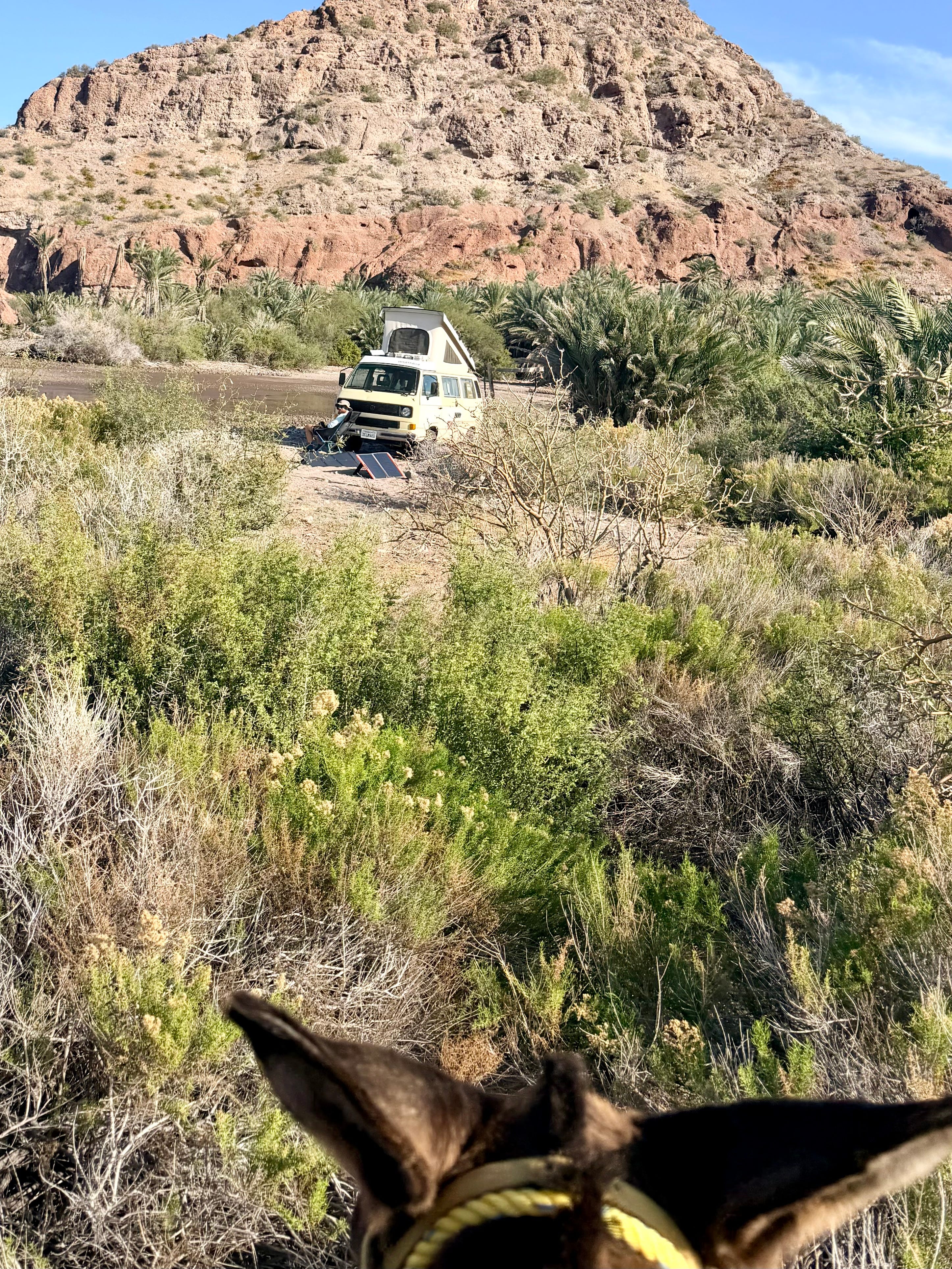
Just as we were entertained by Mark’s helicopter antics, he snapped a picture of us and our donkey antics. Complimenting him on his spot, I wondered how I could make my way back here with a couple of Carta Blancas to trade Baja bliss secrets.
We had been warned of the steep descent back down to the beach and how it would go better if we bonded with our beast and knew their name. Unfortunately, I had not been matched with ‘Pinto’ or ‘Oyo.’ My donkey’s name had many syllables that I quickly forgot. Clearly unimpressed with me, he bolted straight up a ridge before the descent, pulling me with him.
A vaquero quickly intervened to save my life, pulling him back down to the path punctuated with a healthy slap on the ass.2 Back on the beach I was happy to walk on my own sore legs. The day would’ve gone better with that hiking stick.
A taco shack had set up on the beach in front of Montana man’s rig with a lean-to and a few tables. Fresh caught, fish was $50 pesos; shrimp $60. The tacos came with a big platter sectioned off with lime, cabbage, cucumber, guacamole and salsa. The lady running the stand took our pesos and we watched as she cut and mixed everything up while the fish fried.
Waiting for the tacos, I spent the rest of my pesos at the Romero burro family’s craft table. I tried on many bracelets. Señor Romero knew enough English, and I enough Spanish, to understand that he made the one I picked from leather and shark; it was $200 pesos.3
Had Cave Hermit, Montana Man, Vanagon Beach Lord, Mark — gotten away from it all? Did the locals — the fishermen in the village, the vaqueros, the lady running the taco stand — also want to get away from it all?
Stuffing a fat taco in my mouth, admiring my new bracelet, I considered the romanticized simple life. I’m certain the locals feel the same burden of problems, probably more — just different. For me, the day’s demands on my body satisfied my mind.
Dusk set in, the breeze picked up and we got back into skiffs to our boat.
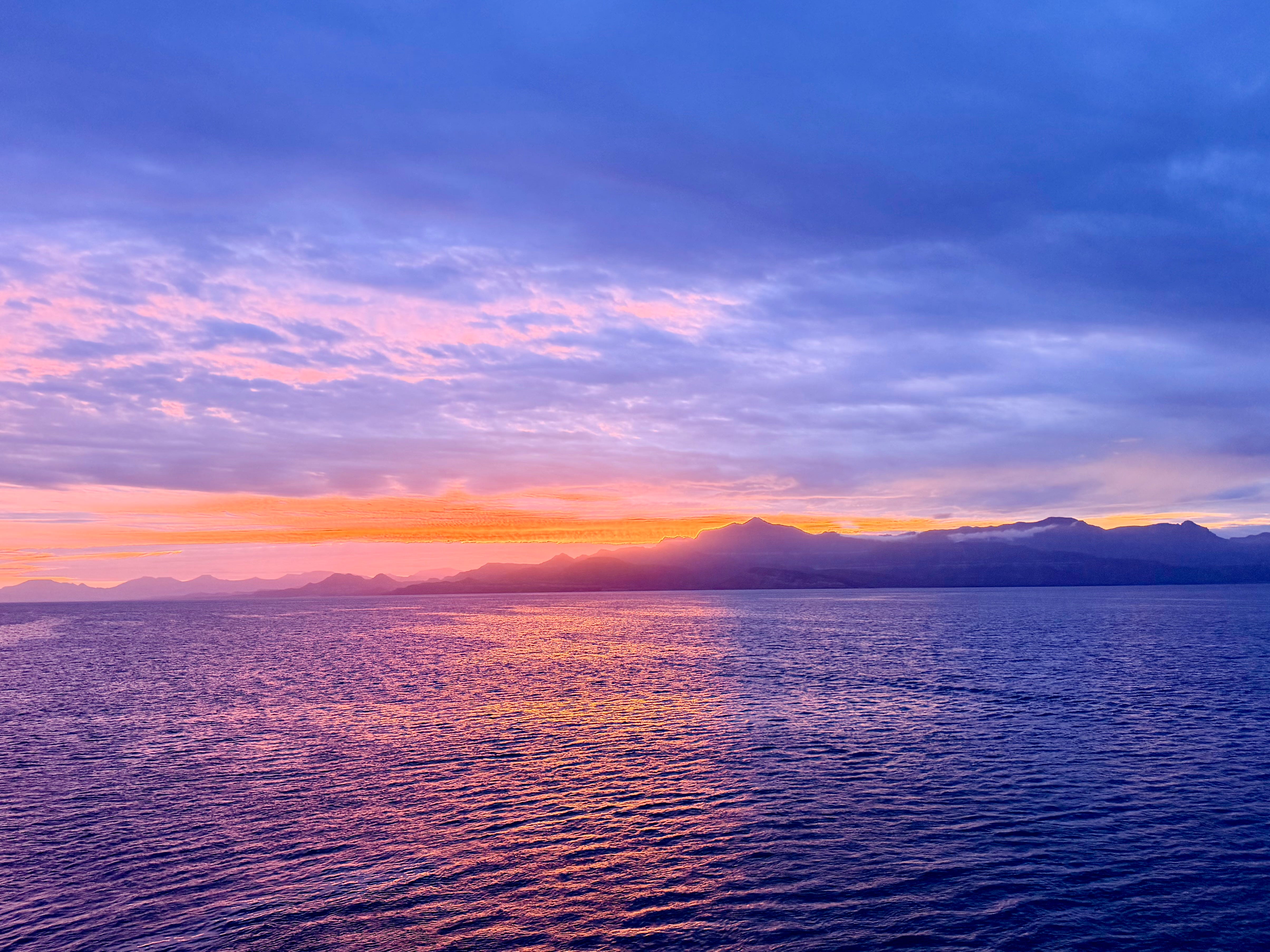
Onboard, I caught the sunset:
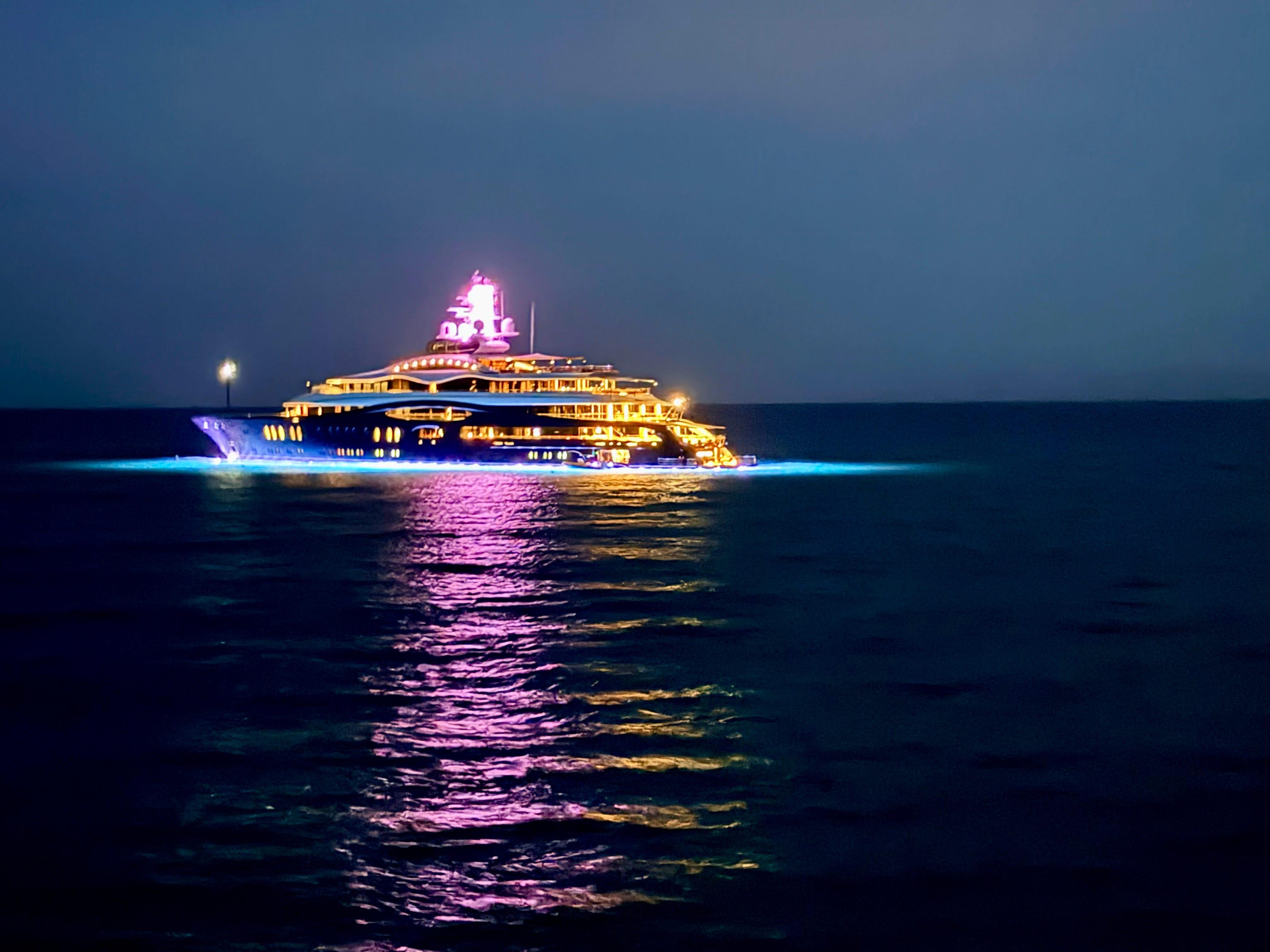
Behind us, Mark’s boat lit up like a Christmas Tree:
Several days — and a new year — later we landed back in Oakland. The temperature dropped twenty degrees. It was raining and I fished a jacket from the bottom of my backpack to go look for the car. It dumped rain the entire drive home from the airport.
Baja was fading fast. But I was happy to get back home, back to it all. As far as I can tell, none of it had changed, except maybe me — just a little bit.
Our crew was abuzz about Mark’s yacht first thing in the morning when Launchpad followed us into the harbor with its support boat Wingman close behind. They travel as a pair and that’s where the helicopter lives with all the toys. By the time we returned to our boat, Wingman had deployed a bunch of jet skis to Launchpad, strung off the stern like a handful of pearls. Our boat had 100 passengers and crew and zero jet skis; Launchpad is twice as big — 400 feet long, more than a football field. Wingman is nearly as big as Launchpad.
Is an ass’s ass still an ass? Regardless, the slap was on the donkey’s, not mine.
Tacos were a couple of US dollars; the bracelet, ten.
Your illustration of the caveman and then the yacht is a good contrast or parallelism. I wonder if you did this intentionally, or if you wrote this as is.
"I'm certain the locals feel the same burden of problems, probably more, just different" - you're right!
It's easy to look at a fishing village and think everyone there has achieved some kind of zen enlightenment through manual labor and fish tacos. But the lady at the taco stand is probably stressed about supply costs and the vaqueros are dealing with difficult gringos who can't remember their donkey's name. The grass is always greener, even when the grass is thorny scrub and angry brambles.
I love that you encountered this entire spectrum of escape. Thank you for sharing it with us, Andrew.
Happy Friday!