

I met my new high school kids Tuesday and pitched this AI Busters idea:
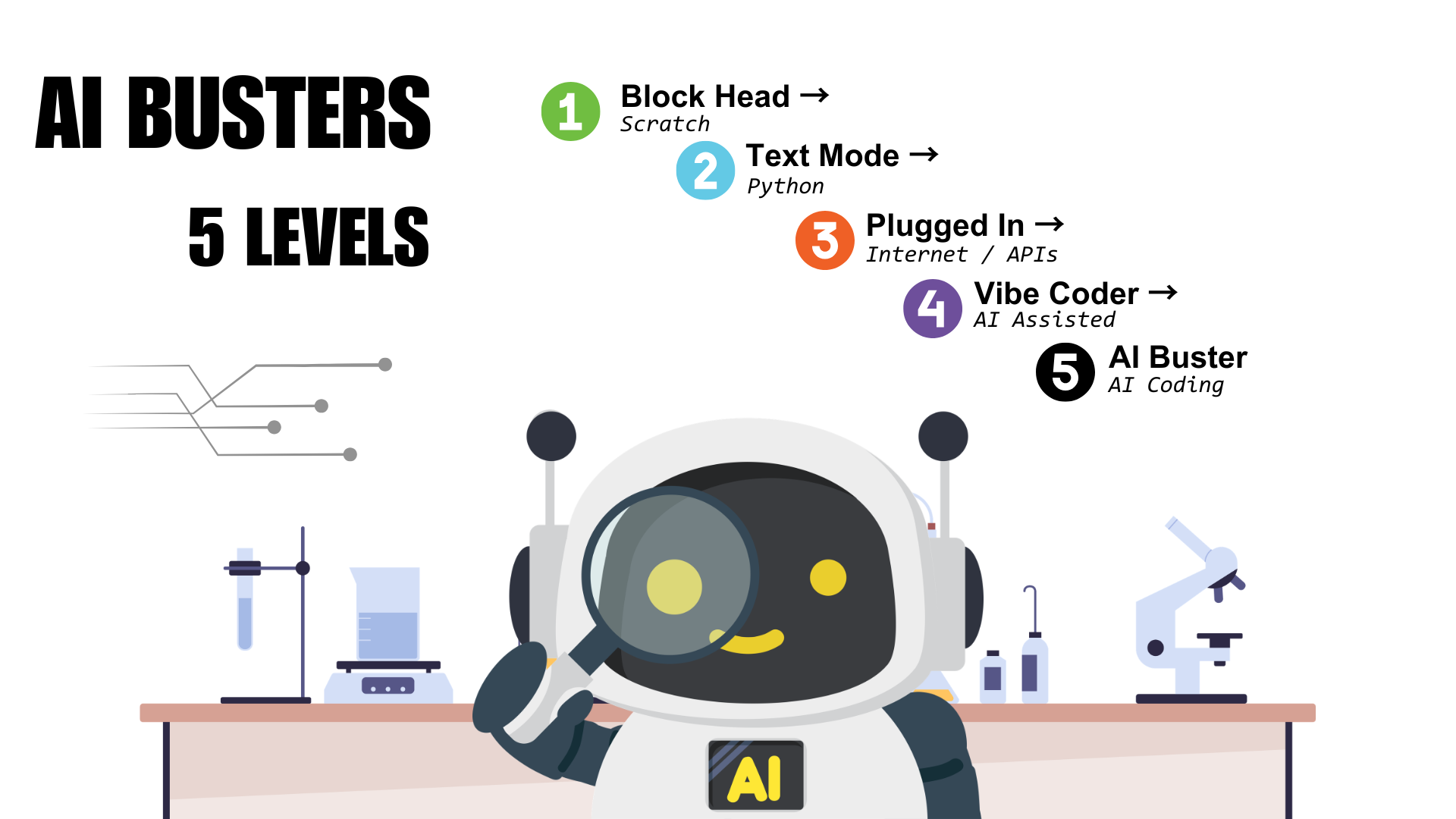
AI has become mythical. Meaning its capabilities and impact are widely distorted, politicized and polarizing.
My pitch to these kids is - love it or hate it - know it. My inspiration is the old TV show MythBusters that unpacked the science behind the myth.
Important stuff like:
Yesterday I had my first class with these kids. A handful opted in and we got off to a rough start. Level 1 in my 6-week block is working in a graphical LEGO-esque coding environment called Scratch, but the school’s IT department blocked access to it: https://scratch.mit.edu.
But these kids are smart; we figured it out. Here’s a game one of the kids built:
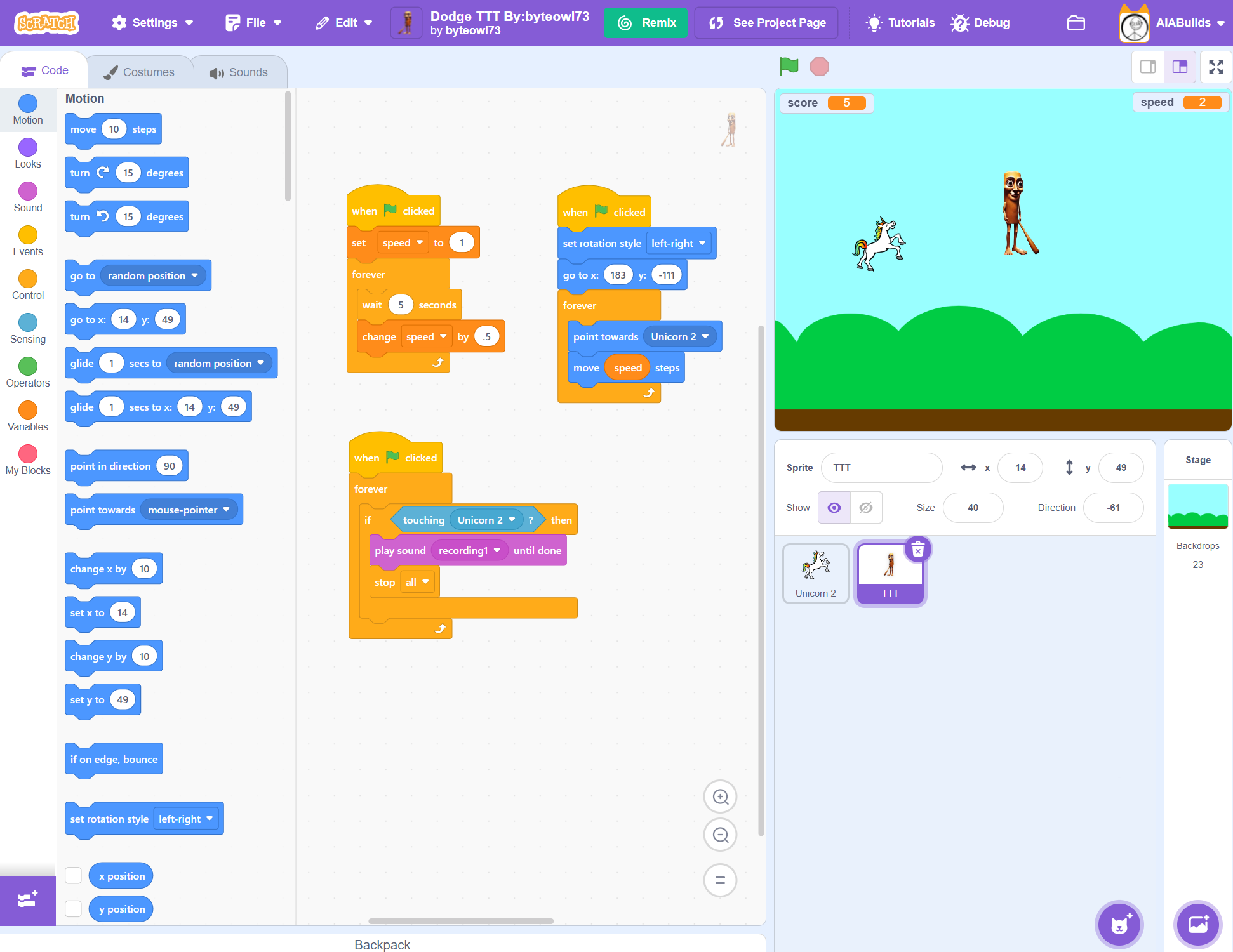
This kid was amazing, but it’s a diverse group so we’ll see how it goes.
Last year around half my AP class started in Scratch and stayed there. I was kind of annoyed by it — didn’t feel like real programming at the time — but after spending some time with it I’m really impressed. The floor is low: it’s super easy to get started, while the ceiling is high: there is a ton you can do.
Scratch evolved out of earlier block programming languages for kids (remember Logo and the turtles?). Its reach and impact are massive. 150+ million kids have learned about programming on Scratch.
It’s out of MIT.

This is my third go with MIT. The first was when I was these kids’ age — in 9th grade.
We were in Boston visiting my mom’s best friend from college when my mom decided I should go to MIT. So we went to visit. I was pretty overwhelmed wandering around a massive campus far from home.
I left with a heavy catalog of courses I couldn’t understand.
I never applied to MIT but twenty years later I found myself back there. I was on a newly formed and somewhat pretentious team of consulting ‘Architects’ at Microsoft and we had some kind of partnership with MIT’s Sloan School of Business.
It was a terribly boring week. I didn’t like my new Architect friends much and the lectures were dry. Topics like IT Governance and Enterprise Architecture. I was never much for theoretical stuff like this; give me something to build.
I’m optimistic about the third go. Next week we’ll stay in Scratch where they learn how computers think without the terminology and testing my kids last year had to endure.
We’re using AI from the start. Today we used a Debugging Agent when we got stuck. Next week we’ll use a Brainstorm Agent to come up with project ideas. After that we’ll progress to Python, using AI all the while as our companion to build increasingly complex and capable programs.
AI is a tricky problem for every industry, but especially education. My old school has no CS classes this year, no cell phones allowed in class, and generally discourages AI use.
I don’t think that’s the way to go.
MIT is trying to figure it out on a grander scale. They published this ‘call to action’ last week: https://aiandeducation.mit.edu/report/
It’s 38 pages. Lots of summary and consensus and conclusions but not much action.
I like their problem statement:
Some technological innovations emerge gradually: As society and technology evolve in concert, mutual adaptation softens the impact. The computer – AI's precursor and key enabler – fits this pattern. Other innovations land more abruptly, becoming socially consequential before individuals and institutions have time to adapt.
Society tends to peg the “birth” of a new technology as the point when it becomes readily usable. By that measure, generative artificial intelligence was “born” with the release of ChatGPT in late 2022. Public engagement with generative AI is therefore less than four years old. In that time, it has amassed more than a billion users, and the companies selling AI technology have come to dominate the headlines, the stock market, and public consciousness.
In other words, AI is progressing across almost every domain and on a timescale too compressed for society to properly observe and analyze its impacts and then gradually adapt.
So AI changes everything, we must act now, but we need some more committees to decide what to do. It reminds me of that weeklong MIT seminar when I was at Microsoft. Lots of talking. Lots of committees. Lots of groups.
The bigger the org, the slower to move and that’s where you get in trouble with a technology that isn’t waiting for society to evolve with it.
In my class of 9th graders we can do whatever we want.