

One day AI will save us and the next day it will end us. If a hype-cycle has a point of peak-punditry, that’s where we’re at.
Ethan Mollick is a guy I started following when AI burst on the scene. He’s a professor at NYU and his first article of 2026 was on a new AI tool for programmers. The article is called Claude Code and What Comes Next.
Claude Code is stupid fun — more on that later — and Ethan concludes:
… today's AIs are capable of real, sustained work that actually matters.
Ethan is on one side of the spectrum of AI pundits, writing measured critiques that focus on understanding these new tools and how they might affect our society. Nearly 400,000 people subscribe to Ethan’s Substack and that article got a lot of attention.
Gary Marcus is another NYU guy but he’s on the other end of the spectrum, writing about the dangers, players and failures of AI. While Gary’s following is smaller at 100,000 subscribers, it’s still substantial. Gary’s first article of 2026 also had a ton of engagement called:
How Generative AI is Destroying Society
GAH!

I have a bad reaction to rage-bait like this. I think it’s from that first election when every media norm got turned upside down and I had to tune out. Consequently, I stay clear of topics that are both controversial and not so interesting to me, like: politics, religion and the NFL.
Unlike football, I know something about tech. I managed to stay afloat through big tech waves for 30 years, watching plenty crash and others turn into tsunamis. Tech eats its young: the PC ate the mainframe, the mobile phone ate landlines, cameras, GPS (and more), Facebook ate the newspapers, YouTube ate the TV and now … AI might eat it all.
Part of AI’s problem is that it has advanced so quickly in the public eye, that it’s hard to not see it as magic. While Ethan wants to help you understand, Marcus uses that misunderstanding to trigger fear. It’s not hard to do — when you don’t understand a thing, you’re more likely to be afraid and stomp on it (if you’re 4) or burn it at the stake (if you’re a Puritan).
But — like I said in one of the first articles I wrote — AI is just a toaster. But the toaster is getting pretty badass.
Let’s take a closer look at Claude Code.
Claude is a product from a newish AI company called Anthropic. Claude gets less airplay than some other consumer AI products like ChatGPT because Anthropic focuses on the enterprise market versus consumer. This is the same way Microsoft runs — that’s where the money is. 1
Anthropic released a big update to Claude just before Christmas.
Claude Code is targeted at professional developers or software engineers. But then something interesting happened — even though Claude Code has a convoluted install process and scary command line based interface — every geek in the world started trying it out.
Why? It’s FUN. It reminds me of the energy of the early Internet before the onslaught of ads and feeds, where it felt like you could build anything, find anything.
FOMO!
Since I left Microsoft, I have a side hustle building websites for local businesses. Let’s see if Claude is about to eat my lunch.
For context, here’s my website. I built it on a platform called WordPress — same way I build client sites. WordPress has been around forever, with a huge ecosystem of themes and plugins. That’s why I use it — the fun of building a website is the creating — not cranking out code.
There are over a billion websites online and WordPress runs around half of them.
Now there’s a billion and one. Here’s the site I built in a few hours this week with Claude Code, using my new logo and color scheme from last week:

Here’s the full site.
When I work up a new site, I listen to what the customer wants from it, ask them to write me up some specifics about their business for copy along with the services they offer, and then we brainstorm visuals and layout. Sometimes they have a logo and branding but if not, I’ll work that up first so the site feels like an extension of their business.
I use AI more and more to help my customers create copy, to work through visuals and design options — and yes when I get stuck on the tech front. I don’t want to work hard. The fun part of building a website is in the creating, getting the customer what they want.
With Claude Code, none of that groundwork goes away. I still had to know what I wanted, sections, layout, images, copy. What I didn’t have to do was fight with WordPress templates over minutiae like pixel padding, plugin crashes, or work around the limitations and byzantine interfaces of website builders.
Claude Code is the most fun I’ve had behind a keyboard in awhile. Will AI put me or other web developers out of a job? No. If anything I can do more for my customers on the creative side. I built a simple static site — a site with a store or regular updates would take a lot more work.
On Monday I built the first iteration of the site. It took me an hour and that included getting the console up and running.2
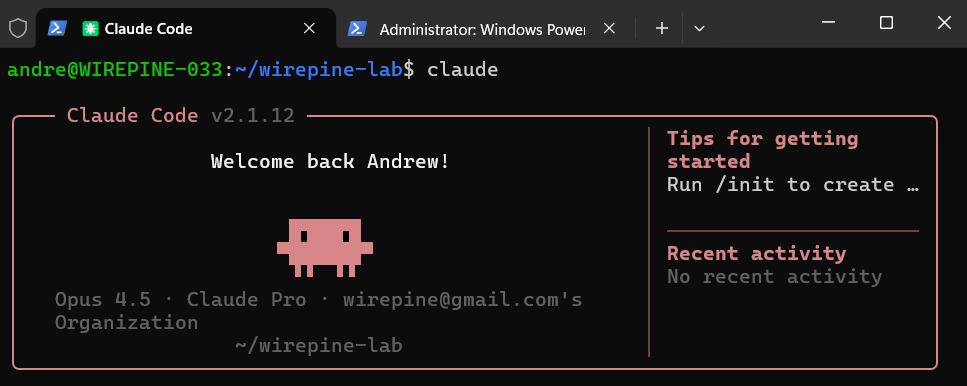
The first iteration of the new wirepinelab.com3 site was basic, but it does stuff even wirepine.com doesn’t do today. For example, I’ve never been satisfied with how my production site just featured a few hand picked static articles from this newsletter. It’s out of date, clunky and doesn’t render well on mobile. I dabbled with trying to get a live feed but it required more plugins and time than I had.
I asked Claude, for approaches to load my latest articles. It gave me some options and we wired it up4.
On Tuesday I woke up excited with new ideas. I put in another couple of hours. It was mostly cosmetic and an excuse to work more on my new wirepine logo. I added a dark mode toggle5 and transitions from the landing page to the rest of the site. Finally, I configured Claude to push updates to a code repository6 which automates the whole publishing process.
Feeling my powers increasing, I asked Claude about building an Easter Egg that would transform the site into a cyberpunk mashup. It was wild watching Claude code an entire Asteroid game in a minute before my eyes. 7
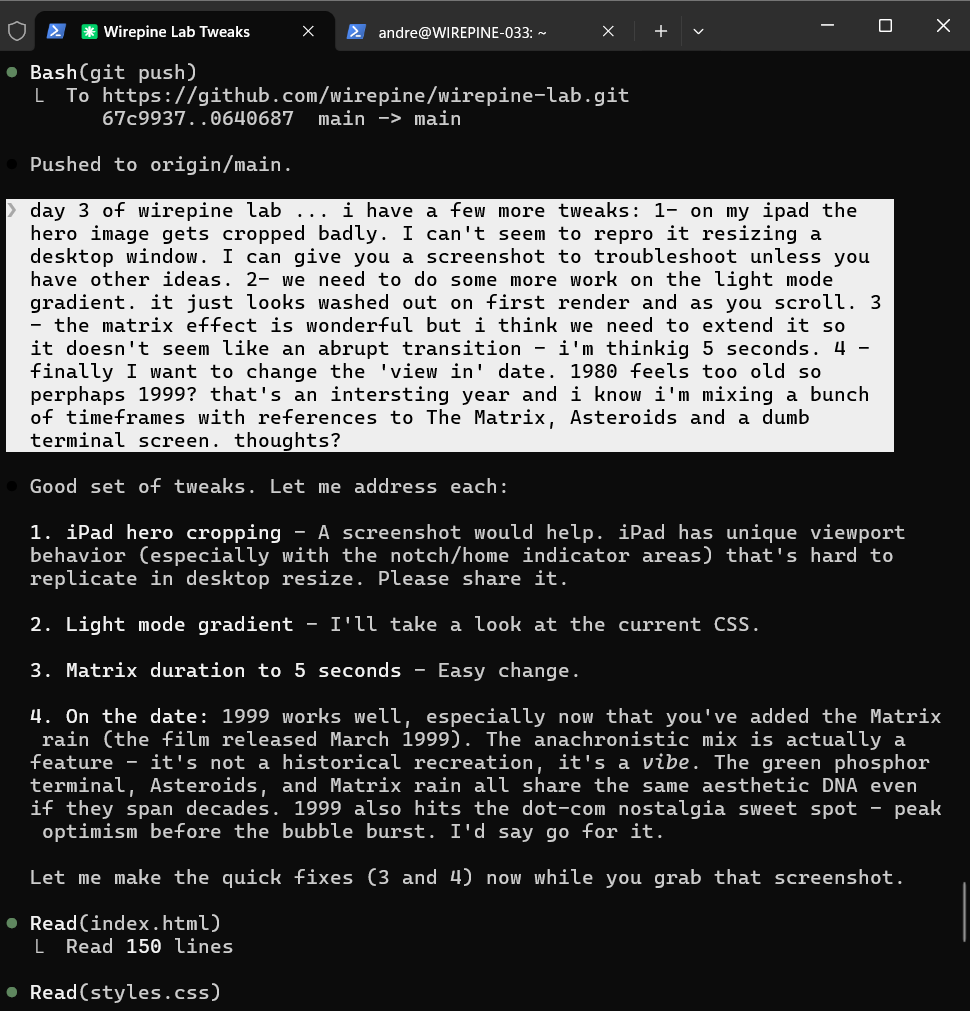
There was a bug in the game straight off. When the ship crashed into an asteroid, the game froze. Claude quickly realized its mistake — it hadn’t allowed a respawn period so the player lost all their lives at once. Easy fix. Inspired, I added a bit more code for a Matrix binary rain transition into a green terminal.
On Wednesday I fixed some bugs. This screenshot shows how this is an iterative coding process, just on steroids:
And on Thursday? I rested.
My favorite movie is Blade Runner. There’s a scene where Deckard (Harrison Ford) is looking for a clue in a picture he found. He feeds the picture into a machine and sits back, nursing a busted lip and cradling a bottle of whisky. He proceeds to analyze the image using simple voice prompts until — sitting up straighter and straighter — he finds someone that was not there before.
gimme a hard copy right there (queue dramatic music):
That’s how I feel using Claude Code.
When I was a freshman in college, I learned how to program in machine language — the most basic instruction set a computer has.
Adding two numbers looked something like this:
Addr  Word   Meaning
0200  7300   CLA CLL        ; clear AC
0201  1210   TAD 210        ; AC += M[0210]
0202  1211   TAD 211        ; AC += M[0211]
0203  3212   DCA 212        ; M[0212] = AC, then clear AC
0204  7402   HLT            ; halt
No keyboard, no screen — you entered each instruction in sequence via a set of binary toggle switches before committing to an address, then the next. Painfully slow. I never wrote a lick of machine language after that class. Why would I? I moved up the stack as fast as I could, using the best tool available to get the most done.
Modern programming systems do a lot: handle code repositories, version control for big teams, automated testing, and integration with other systems. Being able to navigate these complexities with a super smart coding buddy like Claude is now the top of the stack.
Earlier this week, Anthropics CEO said more and more of their code is being written by AI — directed, orchestrated and reviewed by software engineers, but not written by them. His prediction is that in a year this will be commonplace. This is progress, nothing else.
It’s also spurring something unexpected — a wave of creativity. Anyone who has played with Claude is brimming with ideas on how they can use the power of computing to solve problems in their lives or build new things. I have a few ideas myself, but that’s for another time.
For now, AI (and now Claude) helps me build better websites for my customers for less money. My small business customers universally love AI. All of a sudden they have a vast resource of knowledge across domains. Surprisingly they use it mostly to supplement their domain expertise. For example, one of my customers is a residential real estate broker and his team increasingly uses Gemini to pull comps, draft language and write up contracts.
This explosion of creativity makes this Claude Code moment just as significant — perhaps more so — than the release of ChatGPT three years ago.
In my first article of 2026 I hinted that the AI Culture wars will recede this year, and AI will become another historical moniker like PC that really doesn’t stand on its own anymore. As AI gets baked into the tech stack, it just becomes a better way to build and run things.
And that’s just computing. What Claude Code is doing for programming, AI has the potential to do for healthcare, science, education.
So, yeah — I have high hopes for AI. Maybe I’m wrong and this toaster really will end civilization. But until then, I’m making waffles.
Non-ad revenue money. Companies pay you for your software versus selling ads in a feed.
The buzz amongst the AI enthusiast crowd is how scary and foreign working in a command line console is. I guess my age shows here because when I started programming, a blinking cursor in a console was all I had, so I love it. And this one finds and spits out the most complex command syntax for me.
wirepinestage.com is the staging site I use to show builds in progress to customers. I just repurposed it for this experiment.
The initial approach constantly timed out. So we talked over options and switched to a different RSS proxy. We added a lazy load after the page renders with some placeholders to show it’s fetching the latest, along with fallback logic in case the proxy times out.
In Teams, every customer wanted dark mode. It took us six months to ship it.
GitHub. Microsoft bought Github in 2018. It’s the biggest public collaborative code repository in the world. The last team I ran was a group of developers and we used git for all our sample code. Five years later and a little AI … now I get to play. Here’s the public link to the repo I built for the Wirepine lab site — you can check out the code yourself: https://github.com/wirepine/wirepine-lab.
I’ve signed up to go through this with a class of web developers, so I will write this all up in more detail in the coming weeks. I’ll also try Codex (OpenAI’s version of Claude Code) and compare how the different tools work.
My first prompt to Claude laid out some ground rules: no database, no plugins, no frameworks, no admin UI. The site has the bare minimum for a website — two files: index.html for content and styles.css for layout. The Asteroids game is implemented directly in JavaScript inside the page. Strip out the visuals, and what’s left is a small, lightweight site that loads fast and is easy to understand.
I find myself once again an outlier. I had a back-and-forth with an online friend of mine not too long ago. He works for a software outfit and is delighted with Ai coding tools. Despite his job, he *hates* writing software. Loves *creating* it and using it but not *writing* it. Me, OTOH: I have a blog named "The Hard-Core Coder" with the tagline "I can't stop writing code!"
So, I'll use Ai to answer questions — I'm liking it more and more for that — but I love writing and coding too much (they're my hobbies) to let a machine do it. 🤷🏼♂️
As to the putative dangers, I think they are significant. Ai is a very powerful tool. I like the idea that it should be regulated like guns or atomic power. It has the potential to do tremendous damage. We're already seeing it: math and science are being flooded with Ai slop papers — a tsunami too big to be reviewed.
WHEW! Man, this made my brain hurt. LOL! It all looks so interesting, but probably not something I could enjoy or learn. But, I will say that as much as I bitched about AI, I have used it for some ideation, feedback, and fun graphics, and I can see the benefits of streamlining our work. I'll also add that those of us who were around when the Tandy TRS-80 was the shiz have had to adapt and improvise with every technological change, as you mentioned. So why not embrace this new thing? Until it kills us at least. 😜
More to think about after reading this. Weird to think we're so much alike work-wise. You might be in trouble!